
BENNINGTON — MSK Engineers is gearing up to produce a preliminary engineering report on addressing PFAS contamination in homeowner wells on both the southern and northeast ends of town, including the southeast section of Shaftsbury.
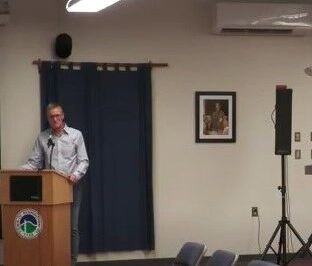
Jason Dolmetsch, of MSK Engineers, included this in a summary he gave the Select Board of ongoing municipal water projects at their meeting on Monday.
The new areas with PFAS contamination include Rocky Lane, Middle Pownal Road, South Stream Road, Coleville Road, Niles Road, and Fuller Road in Bennington and homes along Lower East Road in Shaftsbury.
The Monument Avenue Extension PFAS project Dolmetsch refers to also includes Hickory Hill. This project is in response to the presence of polyfluoroalkyl alkyl substances (PFAS) contamination in private well water. A preliminary engineering report was completed in 2024. Final design has been completed and nearing submission for a state permit application. The estimated construction cost is $8 million; $5 million is available for funding.
A ChemFab factory here — initially on Northside Drive in Bennington — coated fiberglass fabrics and other materials with liquid Teflon containing PFOA. The fabric, which was used in sports stadium domes and other applications, was then dried at high temperatures, resulting in exhaust from the stacks that spread over a wide area. The chemical over time leached into ground water. It is classed as a threat to human health and the environment. The French multinational corporation Saint-Gobain owned the facilities and has paid settlements for the contamination in the past.
Officials expect permitting in the Monument Avenue Extension PFAS project to be complete by the end of the year. At that time the town will need confirm that it will seek monies.
“The state is in talks with Saint-Gobain. They have, I believe, they’ve notified them that they are the potential polluter,” he said. “We encourage the Select Board and the townspeople to begin talking to the state and letting them know that they would like to see a resolution in the same manner that was completed in 2016, if Saint-Gobain comes to the table.”
Resident Tom Kelly said the state should try to get the entire $8 million for the Monument Avenue Extension PFAS project from Saint-Gobain, not just the $3 million more needed. During a meeting with the state in December in Bennington, “it was my understanding that they were having initial discussions with Saint-Gobain about absorbing the total cost of this project, not just whatever we couldn’t get reimbursed from the state. So I strongly suggest that we communicate that to the state DEC that we expect Saint-Gobain to pay everything.”
Acting town manager Dan Monks said he hasn’t been involved in the discussions with the company.
Water pressure upgrades
Dolmetsch also presented about a multi-phase project to address low-system press during “fire-flow event” in the south area of town. This includes Jefferson Heights, Stonehedge Drive, Merson Street, Crescent Boulevard, and Margaret Lane. Planning began in 2008, and the project began in 2014 with construction of new water tank. A two-mile water main has been installed, with 1.4 miles yet to go. The town passed a $4 million bond vote for the remainder of the work in 2023. Final design and permitting was completed in July of 2023.
Because of the identification of contaminated water sources, “we worked with the DPW to start to slow walk this a little bit to see how it may play with work that might be need to be done on Monument Avenue Extension,” he said.
Getting the lead out
Dolmetsch started his presentation with the subject of the identification and replacement of lead water lines in town. “As many of you may know, Bennington had a storied history of installing lead service lines, starting around 1880 and continuing through the 1930s and ’40s,” he said.
However, Bennington was one of the first communities in the country to install corrosion controls treatment, because of both the water quality of its water system as well as the lead service lines in town. “So Bennington has been on the cutting edge of addressing lead service line issues since the ’70s,” he said.
“And then we have approximately 200 that are remaining unknown. So still a little bit of work to do, but we’ve made significant progress on identifying most of the service lines in town,” he said.
The engineers expect to use up all the funding that the town has received to replace as many identified lead service lines as possible by the winter. Then, based on remaining work required to meet a federal standard, as well as address any more lead services lines, they will explore additional funding sources and make a recommendation to the town. There is plenty of time, as the federal standard gives the town until 2034 to complete the work, he said.
By Mark Rondeau, Bennington Banner